
🚀 Whispers from the silent cosmos
The Astonishing Dance of Neutron Stars and Time's Warping Gravity
spacePublished 07 Jan 2026
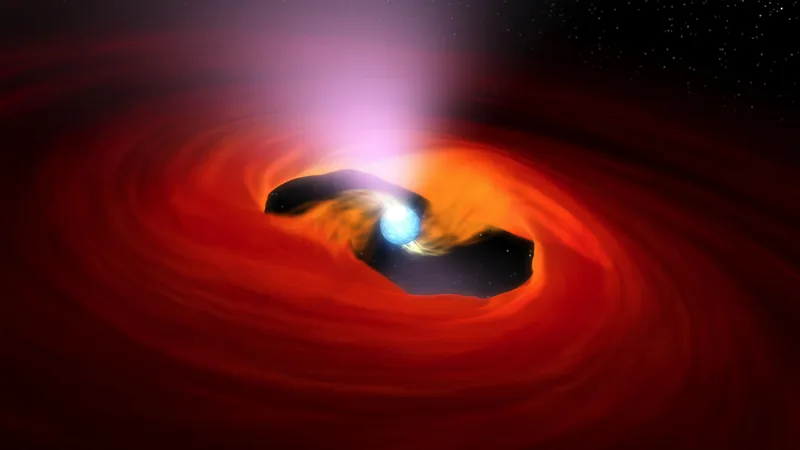
Image by NASA — Public domain
- What: A neutron star spins in the void, warping space with its intense gravity.
- Where: In the cosmos, where neutron stars reside
- When: Observations have been ongoing, with significant insights revealed in 2016
- How: Through pulsar timing variations and gravitational interactions
- Why: Understanding these phenomena deepens our knowledge of the universe and its fundamental forces.
Discovering Pulsars’ Unfathomable Secrets
Imagine a neutron star, a dense remnant of a supernova, spinning relentlessly in the void. As it rotates, it exerts gravity so powerful that it warps the very fabric of space around it. This dance of intense gravitational forces not only affects the star itself but also influences its environment, leading to bizarre phenomena revealed through observations of pulsar timing variations. In these miraculous observations cataloged by various observatories, including radio telescopes, scientists uncovered stirring insights in 2016, where binary systems hinted at the strange consequences of such distorted gravitation. But how do these cosmic entities challenge our understanding of reality?
The Hidden Forces Behind Cosmic Interactions
In a universe that thrives on mystery, the impact of neutron stars is profound yet perplexing. These stars, remnants of stellar explosions, possess masses greater than our Sun, all compressed into a sphere only a few kilometers wide. The pulsars—rapidly rotating neutron stars that emit beams of radiation—serve as cosmic lighthouses. The precise timing of their pulses acts as a cosmic clock. As researchers observed these pulsars, they noted variations in timing that challenge classical physics, particularly in systems where multiple neutron stars interact gravitationally. The result? Pulsars that seem to blink and blur through warped time, prompting scientists to ponder: is gravity itself capable of manipulating the flow of time around these entities?
These findings resonate at the heart of our exploration of spacetime, calling into question our established principles of physics. Gravitational waves, which were directly detected in 2015, loom as a potential frontier where these anomalies could further illuminate the fabric of the universe. With every pulse that reaches our telescopes, we uncover new layers of reality, beckoning us to look closer at the unseen forces that govern the cosmos. The mystery widens as researchers continue to delve into pulsar studies, revealing echoes of an ancient cosmic dance far more intricate than initially believed. What secrets still lie hidden in the whispers of the stars?
Why Pulsar Timing Matters in Our Cosmic Quest
The ongoing investigation into neutron stars and their pulsar timing variations is not merely an academic pursuit; it has profound implications for our understanding of the universe. As scientists unveil the complexities of these celestial bodies, they offer a glimpse into the early universe's conditions and potential ways to unlock the mysteries of dark matter and energy. Human curiosity fuels these explorations, inspiring future generations to gaze into the night sky and wonder. Each pulse of a neutron star echoes with the questions we fear to ask but yearn to answer: What is time? How does gravity truly operate? In these reflections, we catch a glimpse of our place in an unfathomable cosmos, and the quest must go on, driven by the enigma that is time's elusive dance.
Did You Know?
A neutron star can rotate up to 700 times per second, making it one of the fastest spinning objects in the universe.
The gravity of a neutron star is so intense that a teaspoon of its material would weigh about the same as an entire mountain on Earth.
Despite their small size, neutron stars can possess a magnetic field up to a trillion times stronger than Earth's magnetic field, influencing their emissions and surrounding space.
Keep Exploring
CurioWire continues to uncover the world’s hidden histories — one curiosity at a time.
Sources & References
- National Aeronautics and Space Administration (NASA)
- Astrophysical Journal
- European Southern Observatory (ESO)