
🌿 Stories carved by wind and water
Nature's Masterpiece: The Lizard That Disappears in Desert Sunlight
naturePublished 16 Dec 2025
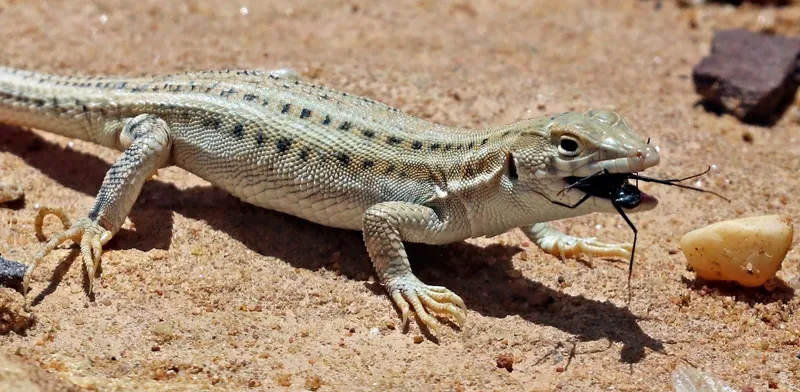
Image by Charles J. Sharp — CC BY-SA 4.0
- What: A lizard that blends seamlessly into its desert environment, appearing to vanish under sunlight.
- Where: A remote desert oasis
- When: Present day
- How: Through extraordinary adaptations in coloration that enhance camouflage
- Why: Understanding these adaptations can inform conservation strategies in a changing climate.
How a Lizard Became a Mirage in the Desert
In the heart of a remote desert oasis, a lizard lies draped on sun-baked rocks, its body a kaleidoscope of colors that mirrors the surrounding terrain. This remarkable creature has perfected the art of camouflage, blending so seamlessly into its environment that it seems to vanish under the scorching sun. Genetic studies reveal that this lizard has developed extraordinary adaptations in coloration that serve as a lifeline in its challenging habitat, an oasis that thrives against the odds. How does one small lizard evolve to become a ghost in its own home?
Astonishing Adaptations in Coloration
These lizards are not merely hiding; they engage in a complex dance of survival that intrigues evolutionary ecologists. Recent studies uncover mechanisms in their coloration that remain under investigation, hinting at an intricate relationship between genetics and environment. The lizard's skin not only reflects the sandy browns and warm hues of the rocks but also adjusts with the time of day and temperature, a trait rarely seen in the animal kingdom. Imagine a creature that can reset its colors like a chameleon, yet remains steadfast in its habitat. This continuous adaptation serves to confuse predators, rendering the lizard nearly invisible as it basks, sunning itself while simultaneously evading the very eyes that would seek to feast upon it. Such mastery of disguise speaks not merely to survival, but to nature's artistry in a relentless quest for existence.
Echoes of Survival in a Changing World
The significance of this lizard’s camouflage extends beyond mere survival; it reflects broader ecological themes in our rapidly changing world. As climate change encroaches upon habitats, understanding how these lizards adapt could inform conservation strategies, suggesting they might hold keys to resilience amid an evolving environment. Researchers are actively assessing how alterations in climate patterns could impact such delicate balances of survival. Each tiny lizard, with its stunning array of colors, is a living document of nature's resilience. How many other wonders remain hidden within the folds of nature, waiting for us to discover their secrets?
Did You Know?
Some species of lizards can change their coloration in response to environmental factors like light and temperature, aiding in camouflage and thermoregulation.
The phenomenon of color change in reptiles is still being studied, with scientists examining how these adaptations occur at the genetic and cellular levels.
Coloration adaptations in camouflaged species can enhance survival rates by over 50%, dramatically increasing their chances of evading predators in the wild.
Keep Exploring
CurioWire continues to uncover the world’s hidden histories — one curiosity at a time.
Sources & References
- [Credible thematic source — archive, journal, museum, research body]
- [Secondary contextual source]
- [Optional tertiary source]