
🧪 Echoes from the lab
The Quantum Mystery of Entangled Particles Altering Reality
sciencePublished 08 Dec 2025
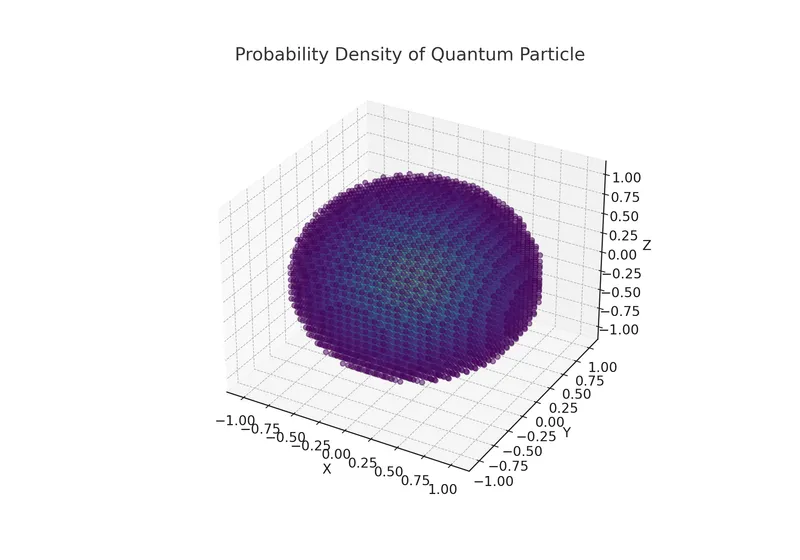
Image via Wikimedia Commons
- What: Quantum entanglement reveals that two particles can influence each other instantaneously, regardless of distance.
- Where: In the realm of quantum physics
- When: Late 20th century
- How: Through experiments demonstrating that measuring one entangled particle determines the state of another.
- Why: It underpins advancements in quantum computing and secure communication, reshaping our understanding of reality.
Unraveling the Enigma of Quantum Entanglement
In a world where reality bends like light through a prism, the phenomenon of quantum entanglement stands as an awe-inspiring paradox. In the late 20th century, physicists demonstrated that entangled particles can influence one another instantly, regardless of distance. This defies classical concepts of locality and introduces the unsettling idea that the behavior of one particle can be correlated with another, even when separated by vast cosmic distances. How can a particle situated on Earth affect one a galaxy away at the very moment it is observed?
The Groundbreaking Experiments of the Late 20th Century
The pivotal discoveries began with the experiments led by Alain Aspect and his team at the University of Paris in the early 1980s, which set the stage for later revelations in quantum mechanics. They showed that when particles like photons become entangled, measuring the state of one automatically determines the state of the other, even if separated by vast distances. This instantaneous interaction echoes Einstein’s discomfort that he termed “spooky action at a distance,” raising fundamental questions about the nature of measurement itself as well as our deep-seated understandings of reality. The idea that observation impacts existence revolutionizes not only physics but also enhances our philosophical contemplations about the universe.
The Relevance of Quantum, Entanglement and Measurement Today
The reason this matters today is that quantum entanglement underpins revolutionary technological advancements, such as quantum computing and secure communication. Research at institutions like IBM's Quantum Labs indicates that entangled particles serve as a basis for developing computers capable of performing calculations unreachable for classical machines. Moreover, experiments have shown that entangled photons can be used for ultra-secure communication channels, revolutionizing how data might be transmitted across networks. As we venture deeper into the quantum world, these implications challenge our everyday understanding of locality and connect us more intimately with the universe's profound mysteries. A reflection on entanglement not only invites awe but kindles further curiosity about our existence and place in this intricate web of reality.
Did You Know?
In quantum entanglement, two particles remain interconnected regardless of the space that separates them, influencing each other instantaneously.
Alain Aspect's experiments in the 1980s successfully demonstrated that measurement can influence the behavior of entangled particles, providing empirical evidence for quantum mechanics.
Despite its counterintuitive nature, quantum entanglement has been proposed as a basis for developing next-generation technologies such as quantum computers and ultra-secure communication networks.
Keep Exploring
CurioWire continues to uncover the world’s hidden histories — one curiosity at a time.
Sources & References
- American Physical Society — Quantum Entanglement Overview
- Nature — Quantum Mechanics and Its Implications
- IBM Quantum — Advancements in Quantum Computing