
🚀 Whispers from the silent cosmos
A Day on Venus Lasts Longer Than Its Year
spacePublished 29 Nov 2025
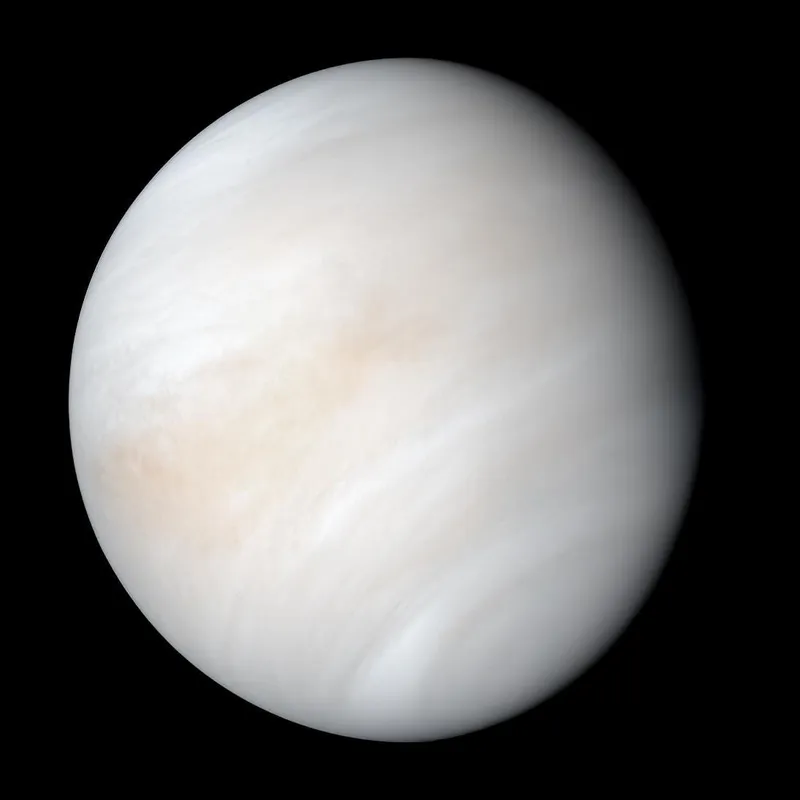
Image via Wikimedia Commons
- What: Venus rotates on its axis more slowly than it orbits the Sun, resulting in a day lasting 243 Earth days while a year lasts only 225 Earth days.
- Where: Venus, the second planet from the Sun
- When: Observations began in the 17th century, with significant discoveries in the mid-20th century
- How: The planet's unique rotation and orbit create a dramatic contrast in timekeeping
- Why: Understanding Venus's time mechanics challenges our perception of time and informs studies of exoplanets and planetary evolution.
The Bizarre Rhythm of Time on Venus
Imagine a world where time behaves not as we know it—a realm where a single day stretches longer than an entire year. On Venus, this curious phenomenon becomes reality. Venus rotates on its axis incredibly slowly, taking about 243 Earth days to complete one full rotation. In contrast, it orbits the Sun in just 225 Earth days, creating a mind-bending scenario that challenges our traditional understanding of time. What implications does this have for our perceptions of the universe and the nature of time itself?
The Discovery of Venus’s Peculiar Timekeeping
The revelation of Venus's astounding temporal anomaly dates back to early observations made by astronomers like Galileo Galilei in the 17th century, who was among the first to study Venus’s phases through a telescope. However, it wasn’t until the mid-20th century that more precise measurements confirmed the planet's unusual spin. NASA's Mariner 10 mission in 1974 and subsequent explorations provided substantial insights into Venus’s slow rotation and its effects on the planet's atmospheric dynamics. The fast orbit of 225 days juxtaposed against the slow rotation raises profound questions about time’s relativity. For instance, the prolonged duration of a day on Venus allows for remarkable atmospheric phenomena, such as sustained periods of intense heat and pressure, with surface temperatures averaging around 900 degrees Fahrenheit (475 degrees Celsius). This extreme environment exemplifies how different planetary conditions can alter an ecosystem's fundamental operations, including the speed of time itself. By exploring Venus, we realize how planets in our solar system can defy our expectations and introduce complexities that echo the cosmic inflation theory. Just as inflation suggests parts of the universe might exhibit distinct time behaviors, Venus symbolizes a tangible example that adjusts our understanding of cosmic time across celestial bodies.
The Cosmic Significance of Venus’s Unique Time Mechanism
The reason this matters today is that it challenges the uniformity of our time perception across the cosmos. As we delve deeper into space exploration and study exoplanets, understanding different planetary rotations and their timekeeping becomes crucial. For instance, consider our recent focus on exoplanets in habitable zones, where conditions might mimic Venus or others, opening discussions about life, weather, and climate cycles there. Moreover, ongoing studies by organizations like the European Space Agency (ESA) aim to explore these mysteries further. The exploration of Venus’s geology and atmosphere might unveil more secrets about Earth’s own evolution and climatic changes. The enormous implications of these differing rhythms invite us to expand our thinking—date and time aren’t absolute; they are dictated by the environment and cosmic mechanics. As we increasingly recognize the variability in planetary conditions, we find ourselves questioning the nature of time itself. Each unique world might illuminate diverse passages of reality that ripple across the universe's vast tapestry.
Did You Know?
1. Venus is often called Earth's twin due to its similar size and composition, but its atmospheric conditions are hostile to life as we know it. 2. The atmospheric pressure on Venus's surface is 92 times that of Earth's, roughly equivalent to being nearly a mile underwater. 3. Some scientists propose that Venus may have once held liquid water, suggesting complex climatic changes in its ancient past.
Keep Exploring
CurioWire continues to uncover the world’s hidden histories — one curiosity at a time.
Sources & References
- NASA — Mariner 10 Mission Overview
- European Space Agency — Venus Exploration Initiatives
- American Astronomical Society — Studies on Planetary Rotation and Climate