
🚀 Whispers from the silent cosmos
The Invisible Dark Matter Connecting Our Galaxies
spacePublished 02 Dec 2025
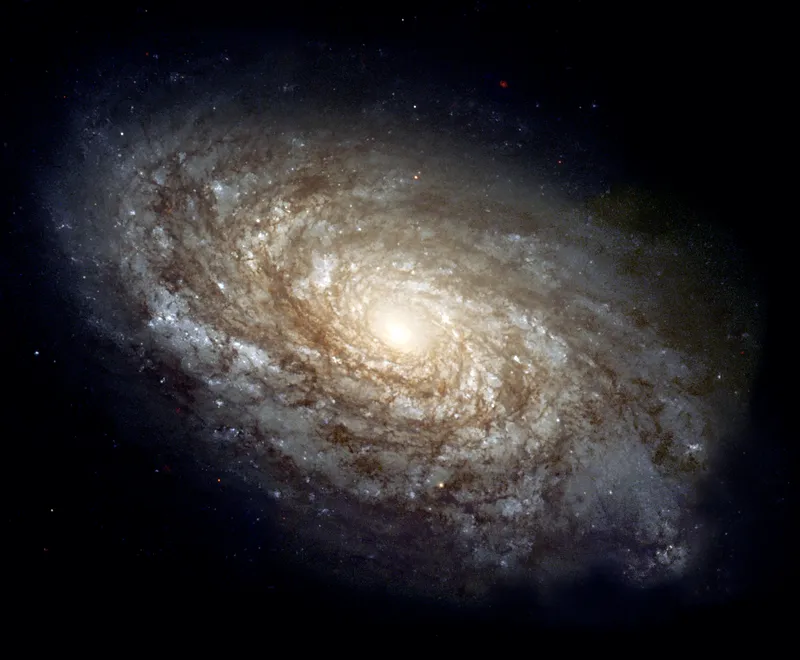
Image via Wikimedia Commons
- What: Dark matter constitutes approximately 27% of the universe and influences the formation and movement of galaxies.
- Where: Across the universe
- When: Current cosmological models
- How: Dark matter's gravitational effects govern cosmic interactions and galactic structures.
- Why: Understanding dark matter is crucial for comprehending the universe's structure and the fate of galaxies.
Unveiling the Cosmic Veil of Dark Matter
Imagine an unseen tapestry stretching across the universe, weaving through the fabric of reality itself. This cosmic veil, primarily composed of dark matter, not only structures our galaxy but also influences countless cosmic interactions. Current cosmological models suggest that dark matter constitutes approximately 27% of the universe, silently governing the formation and movement of galaxies. What remains hidden is how these elusive filaments will shape the destiny of galaxies like our own Milky Way.
The Impending Dance of the Milky Way and Andromeda
In the vastness of space, two celestial giants, the Milky Way and the Andromeda galaxies, are locked in an inexorable gravitational embrace, converging at an astonishing speed of about 110 kilometers per second relative to each other. This cosmic dance, expected to culminate in a merger in approximately 4.5 billion years based on current models, will not only reshape the structure of our Local Group but also alter the dark matter distribution surrounding both galaxies. This monumental event, discussed by scientists for decades and modeled with advanced telescopes and simulations, illustrates the fundamental role dark matter plays in galactic evolution. The interactions between these mega-galaxies may create new stars and potentially reignite star formation in regions previously dormant, although this outcome depends on various factors. This celestial merger unveils the powerful undercurrents of dark matter, revealing how it acts as the scaffolding for galaxy formation while simultaneously pulling the cosmic strings of their destinies.
Why Understanding Dark Matter Matters Today
The reason this matters today is that our understanding of dark matter helps us comprehend the universe's intricate structure and evolution. Insights gained from studying galactic interactions—like the imminent merger of the Milky Way and Andromeda—are crucial for modern astrophysics. Researchers at the European Southern Observatory have delved into the properties of dark matter, linking its gravitational effects to galaxies' movements and their structural formations. This knowledge not only enhances our grasp of cosmic history but also offers clues to the potential fate of our galaxy. As we ponder the vastness of time and space, we are reminded that even the invisible threads of dark matter shape our reality, connecting us to others across the universe in ways we are just beginning to understand.
Did You Know?
Dark matter is so elusive that it does not emit or absorb light, making it invisible to traditional telescopes and detectable only through its gravitational effects.
Astronomers estimate that the Milky Way contains up to six times more dark matter than visible matter, fundamentally shaping its structure and dynamics.
Galactic collisions, like that of the Milky Way and Andromeda, can potentially trigger a burst of star formation, giving rise to millions of new stars in a relatively short cosmic time frame, although this is not guaranteed.
Keep Exploring
CurioWire continues to uncover the world’s hidden histories — one curiosity at a time.
Sources & References
- European Southern Observatory
- NASA Astrophysics Data System
- Journal of Cosmology and Astroparticle Physics