
🚀 Whispers from the silent cosmos
The Surprising Connections Between Black Holes and Vastness of Stars
spacePublished 27 Nov 2025
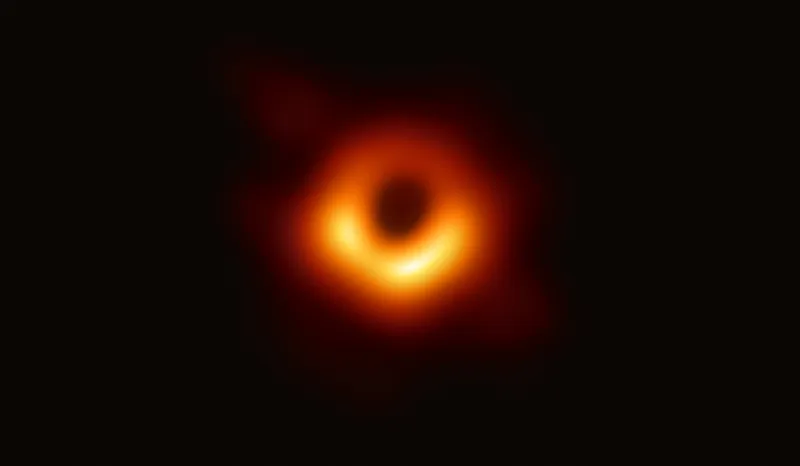
Image via Wikimedia Commons
- What: Black holes represent a profound paradox in our understanding of the universe, illustrating the intricate relationship between gravity and the vastness of stars.
- Where: The cosmos, specifically within binary star systems like Cygnus X-1.
- When: Significant discoveries began in 1971, continuing into the present.
- How: Through the study of gravitational effects and the event horizon, scientists explore the nature of black holes.
- Why: Understanding black holes is crucial for unraveling fundamental questions about time, space, and the universe's structure.
The Universe's Labyrinth of Stars and Black Holes
At the very edge of our understanding lies a cosmic expanse that stretches beyond imagination. Picture this: for every grain of sand found on all the Earth's beaches, there exist more stars in our universe. This staggering visual encapsulates the vastness of our cosmos, yet what truly astounds is how every grain would fit within the event horizon of a black hole if we were to compress the entire Earth into a singularity. How does such a paradox reflect the very nature of existence itself?
The Gravitational Dance of Black Holes
In 1971, astronomers were thrust into the bewildering world of black holes as the first strong evidence for their existence emerged. This revelation stemmed from the discovery of Cygnus X-1, a binary star system located approximately 6,000 light-years from Earth. A companion star was observed orbiting an invisible, massive object, suggesting the undeniable presence of a black hole. This monumental finding transformed scientific perspectives, illustrating how gravity could warp space and time — a phenomenon that defies our conventional understanding of reality. The event horizon, or the boundary surrounding a black hole, exemplifies this distortion. Once an object crosses this threshold, no information can escape; it becomes lost to our cosmos. This principle resonates with the universe’s enigmatic nature — where not only are stars prevalent, but the fine lines between light and dark are intricately tied to how we perceive existence. Black holes exemplify nature's uncanny ability to create structures as massive as entire stars, yet with confines so small that they appear to defy logic. Additionally, the sheer size of the universe amplifies this cosmic play. The estimated number of stars tops out at about 100 billion galaxies, each containing millions to trillions of stars. The juxtaposition of this enormity against the idea that an entire Earth could fit within a single black hole provokes a profound reconsideration of scale, existence, and the gravity that binds the fabric of our universe.
Implications of Cosmic Discovery Today
The reason this matters today is that our quest to understand black holes sheds light on fundamental questions regarding time, space, and the cosmos itself. The eerie silence of black holes challenges physicists to confront ideas about how the universe operates under extreme conditions. Many contemporary researchers, like Dr. Andrew Strominger from Harvard University, are exploring the connections between black hole thermodynamics and quantum mechanics to decode these mysteries further. Current investigations also echo ancient philosophies pondering the constraints of our reality. In our modern age, telescopes like the Event Horizon Telescope have captured the first direct images of black holes, further enriching our comprehension of these celestial giants and their gravitational influences. This research not only captivates public interest but ignites curiosity about the universe's vastness, creating possible links to dark matter and energy — phenomena that still elude complete understanding. Much like the grains of sand that symbolize our perceptions, every discovery about black holes offers a glimpse into the labyrinthine corridors of our universe, urging us to reconsider our own existence within it.
Did You Know?
- A black hole's event horizon marks the point where gravity pulls so strongly that nothing, not even light, can escape it, leading to their infamous darkness. - The Milky Way, our home galaxy, is estimated to harbor at least one supermassive black hole at its center, known as Sagittarius A*, with a mass equivalent to about 4 million suns. - Studies suggest that black holes could be portals to other universes, indicating that their mysterious properties may lead to realms beyond our own understanding.
Keep Exploring
CurioWire continues to uncover the world’s hidden histories — one curiosity at a time.
Sources & References
- NASA — Black Holes: A Brief History of Their Discovery
- Harvard University — Dr. Andrew Strominger's Research on Black Holes
- Event Horizon Telescope Collaboration — First Image of a Black Hole