
🧪 Echoes from the lab
The Ancient Coelacanth: Defying Extinction's Grasp
sciencePublished 12 Jan 2026
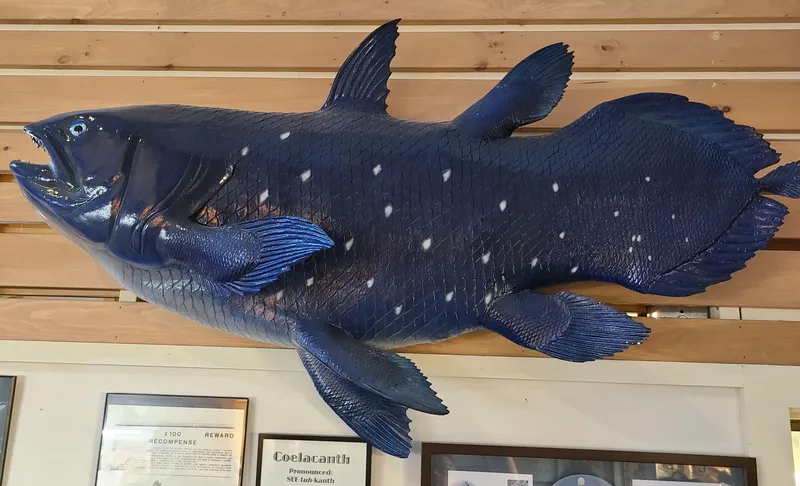
Image by Bigmacthealmanac — CC BY-SA 4.0
- What: The coelacanth, a fish thought extinct for 66 million years, was rediscovered off the coast of South Africa in 1938.
- Where: Off the coast of South Africa
- When: 1938
- How: It survived through subtle evolutionary changes while resisting extinction pressures.
- Why: Its existence challenges traditional evolutionary narratives and offers insights into biodiversity and conservation.
Uncovering the Surprising Legacy of Coelacanths
Imagine a creature thought to be lost to time, swimming off the coast of South Africa in 1938. The coelacanth, a fish believed extinct for 66 million years, reemerged from the depths, rewiring our understanding of evolutionary timelines. This astounding discovery unlocked questions about how species can seemingly defy the relentless pressures of extinction. What hidden adaptations allow such ancient life forms to thrive against the odds?
Ancient Echoes in Coelacanth Fossil Records
The fossil records of coelacanths from the Devonian period present a striking tableau of survival that confounds scientists and evokes a sense of reverence. Some researchers continue to debate the implications of these fossils, which suggest that this ancient lineage has resisted the gravitational pull of extinction while undergoing subtle evolutionary changes. Their very existence challenges the prevailing narratives of evolutionary biology — one that heavily emphasizes survival of the fittest. Instead, the coelacanth represents a paradox, raising the possibility of "evolutionary stasis," where certain species endure through geological epochs with little change, even as their ecosystems undergo radical shifts. This remarkable capability might hint at intricate feedback loops, mechanisms woven into their biology and environmental interactions, allowing them to adapt and persist in a world that is ever-evolving.
Lessons from the Depths: Evolutionary Insights
The coelacanth’s resilient nature resonates in contemporary discussions about biodiversity and conservation. As we witness a modern extinction crisis, understanding how ancient species like the coelacanth can sidestep extinction could provide crucial insights into preserving today’s endangered species. A modern study connecting habitat stability with species resiliency suggests that complex ecosystems, much like those nurturing the coelacanth, may be vital for ensuring survival against environmental changes. The coelacanth stands as a living testament to history’s whispers, urging us to reconsider how we define resilience and survival in a world full of uncertainty. How many more secrets do the depths of our planet still hold?
Did You Know?
The coelacanth was rediscovered in 1938 off the coast of South Africa, shocking the scientific community who believed it had been extinct for millions of years.
This ancient fish can grow up to 2 meters (6.5 feet) long and is known for its unique lobe-finned structure, setting it apart from most other fish.
Coelacanths have a unique method of reproduction, giving birth to live young rather than laying eggs, a trait that adds to their evolutionary intrigue.
Keep Exploring
CurioWire continues to uncover the world’s hidden histories — one curiosity at a time.
Sources & References
- National Museum of Natural History
- Paleobiology Journal
- Smithsonian Institution