
🏺 Recovered from the dusty archives
The Telescope That Upended Centuries of Cosmic Authority
historyPublished 08 Jan 2026
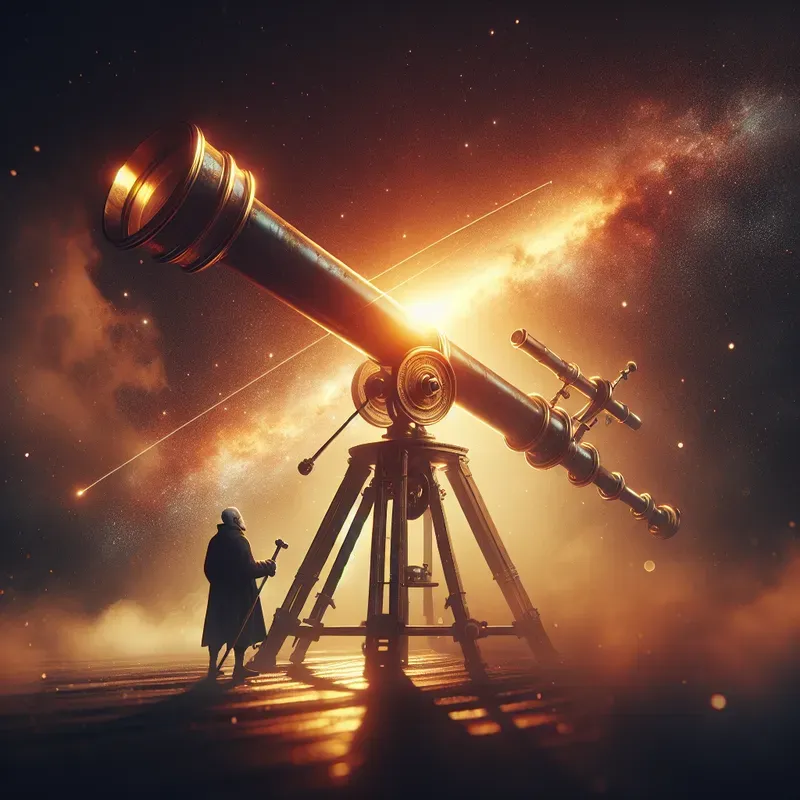
Illustration by DALL·E 3
- What: Galileo's telescope revolutionized astronomical observation and challenged centuries of established authority.
- Where: Italy
- When: Early 17th century
- How: By providing empirical evidence that contradicted ancient texts and authority.
- Why: It highlights the ongoing tension between innovation and tradition in the pursuit of knowledge.
How a Simple Invention Changed Our View of the Universe
In a quiet Italian town in the early 17th century, a revolutionary tool was born—Galileo’s telescope—heralding a seismic shift in astronomical observation. This ingenious invention did more than merely extend our vision; it ignited a fierce clash between the revered teachings of ancient scholars, particularly Aristotle, and the burgeoning world of scientific inquiry. How could a mere tube with lenses challenge the very foundations of knowledge that had stood for centuries?
Unraveling the Impact of Galileo's Telescope
Galileo Galilei, through his correspondence and meticulous notebooks, documented his findings, forever altering the landscape of human understanding. Until then, the cosmos was primarily interpreted through ancient texts, where authority reigned and empirical observation took a backseat. Recorded observations described celestial bodies behaving in ways that contradicted the established Aristotelian view; for instance, Galileo noted that Jupiter had its moons, orbiting in a dance that begged the question: if not everything revolved around Earth, what did that say about humanity's place in the universe? In challenging these age-old doctrines, Galileo not only advanced the science of astronomy but also set the stage for conflict with the powerful institutions that defended traditional interpretations of the heavens.
The implications of this clash extend beyond mere observations. The concept of “Innovation reshapes ancient authority” encapsulates how revolutionary technology can inadvertently destabilize established power structures. Galileo's bold assertions and innovative methods were a direct affront to the authority of the Church, and this tension between innovation and tradition sparked debates that resonate to this very day. His findings—while meticulously documented—were met with skepticism, often dismissed by those unwilling to relinquish time-honored beliefs.
The Legacy of a Battle Between Science and Tradition
The repercussions of Galileo's discoveries ripple through time, influencing not just scientific thought but also societal structures. In a modern context, the struggle between established authority and emerging innovations persists, as echoed in current scientific debates about climate change and health pandemics. The legacy of Galileo’s confrontation serves as a sobering reminder of our ongoing battle with accepted truths. It raises significant questions about the power dynamics in knowledge creation—who gets to interpret truth, and what happens when new evidence disrupts established narratives? As such, Galileo’s telescope is not merely an instrument; it is emblematic of humanity’s relentless pursuit of understanding, pushing us to question and reevaluate our perceptions of the known universe.
Did You Know?
Prior to Galileo, the idea of a heliocentric universe, where the sun, not the Earth, lay at the center, was still heavily debated and largely dismissed.
Galileo’s observations of sunspots suggested that the sun was not a perfect celestial body, undermining Aristotle’s belief in the immutability of the heavens.
In 1610, Galileo published "Sidereus Nuncius," a groundbreaking work that detailed his astronomical discoveries, making him a central figure of the Scientific Revolution.
Keep Exploring
CurioWire continues to uncover the world’s hidden histories — one curiosity at a time.
Sources & References
- Galileo Museum
- Royal Astronomical Society
- American Journal of Physics