
🚀 Whispers from the silent cosmos
Jupiter's Great Red Spot Faces Unprecedented Changes
spacePublished 08 Jan 2026
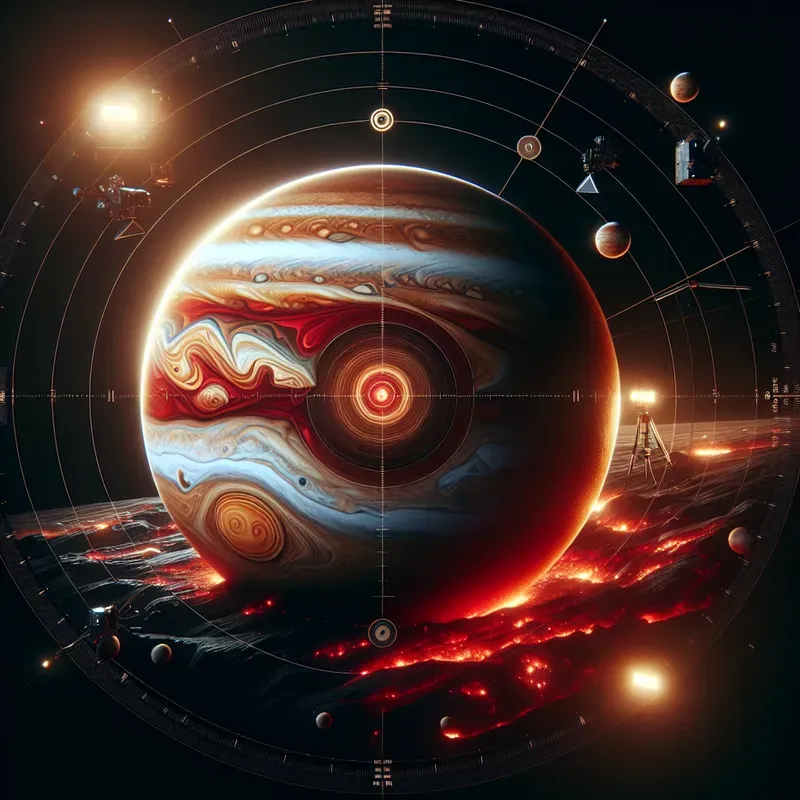
Illustration by DALL·E 3
- What: The Great Red Spot, a colossal storm on Jupiter, is undergoing significant changes that threaten its stability.
- Where: Jupiter
- When: Over the past 350 years
- How: Fluctuations in Jupiter's atmospheric dynamics are impacting the storm's longevity.
- Why: Understanding these changes may provide insights into planetary weather systems across the cosmos.
A Celestial Storm with an Uncertain Future
For over 350 years, Jupiter’s Great Red Spot has raged in the gas giant's atmosphere, a colossal storm so massive it can swallow Earth whole. Observations from the Hubble Space Telescope reveal that this iconic storm is now facing a dramatic transformation, raising critical questions about its stability. Some researchers speculate that fluctuations in Jupiter's atmospheric dynamics could threaten its longevity, leading us to ponder — are we witnessing the end of an age-old tempest?
The Great Red Spot and Its Evolving Mysteries
The Great Red Spot is not merely a storm but a symbol of the mysterious and variable nature of planetary atmospheres. Historical storm data compiled from Hubble have shown that this tempest has not only persisted but evolved over the centuries. Yet, models indicate an unsettling continuity: the stability of this magnificent storm is increasingly threatened. Archival records describe similar storms on Jupiter that have appeared and dissipated much more rapidly than previously anticipated. While the Great Red Spot's existence seemed almost assured, changes in its behavior hint at a fragile existence. Every observation prompts the question: how stable is this massive vortex, and what might its changes tell us about this distant world?
The Implications for Our Understanding of Space Weather
As we delve into these atmospheric dynamics, we uncover both awe and uncertainty about similar planetary systems, not only in our Solar System but across the cosmos. A recent analysis notes that, while the Great Red Spot has endured, its fluctuations encourage scientists to reconsider how we perceive planetary weather systems. Such mutations could provide vital insights into storm formation mechanisms on exoplanets, a frontier currently rich with mystery. This challenge to traditional perceptions accentuates the thrill of exploration in our quest to understand the universe. What lies ahead? Will the legendary Great Red Spot succumb to the winds of change? Only time, and further observation, will reveal the enigmas of Jupiter’s everlasting storm.
Did You Know?
Some researchers suggest that the Great Red Spot has been shrinking in size since the late 1800s, leading to speculation about its potential disappearance.
The storms on Jupiter can create winds of up to 400 miles per hour, making them among the fastest in our Solar System.
Jupiter’s atmosphere is composed mostly of hydrogen and helium, and understanding its storms can help decode the planet's complex weather patterns.
Keep Exploring
CurioWire continues to uncover the world’s hidden histories — one curiosity at a time.
Sources & References
- NASA's Hubble Space Telescope Archives
- Journal of Planetary Science
- American Astronomical Society