
🌿 Stories carved by wind and water
The Astonishing Camouflage of New England's Deep Chameleons
naturePublished 07 Jan 2026
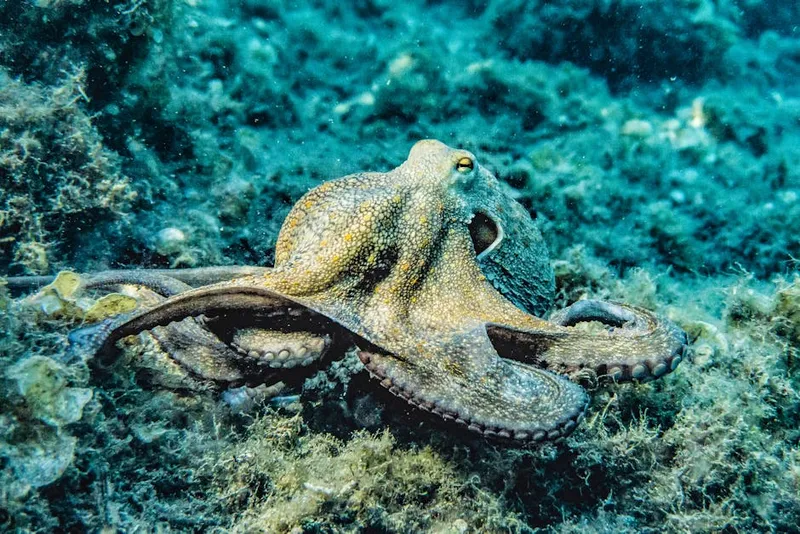
Image courtesy of Pexels
- What: Octopuses in New England exhibit extraordinary camouflage abilities, changing color and texture to survive in tidal zones.
- Where: New England tidal zones
- When: Contemporary observations
- How: Through specialized skin cells called chromatophores that allow rapid alterations in appearance
- Why: Understanding their adaptability provides insights into ecological dynamics and resilience in changing marine environments.
The extraordinary adaptability of octopuses in tidal zones
As ocean currents surge and swirl around the rocky shores of New England, a remarkable transformation quietly unfolds beneath the waves. Octopuses—true chameleons of the deep—can change their shape and color almost instantaneously, a biological marvel that has captivated researchers for decades. Long-term observations of these elusive creatures reveal that their stunning camouflage plays a critical survival role in their tidal zones, where the interplay of predator and prey constantly shifts. Why does this incredible adaptation remain shrouded in mystery?
Inside the world of tidal octopuses and their camouflage
Behavioral studies in ecological ethology have highlighted octopuses as masters of disguise, blending seamlessly into their surroundings despite the seemingly chaotic environments they inhabit. Their ability to alter color and texture, sometimes in a mere heartbeat, challenges traditional evolutionary theories about optimization and efficiency. Observers in the tidal zones note how octopuses can mimic the sandy ocean floor or the brilliantly colored rocks, employing this extraordinary skill to evade predators or ambush unsuspecting prey. Yet, the question remains: how has this sophisticated behavior evolved, and what drives these enigmatic creatures to employ such intricate systems of camouflage?
In these dynamic coastal ecosystems, variability in species interactions complicates interpretations of octopus behavior. Each tide brings a different interplay of light and shadow, nudging octopuses to adapt their masking abilities. Their camouflage isn't merely a survival mechanism; it’s also a mesmerizing demonstration of the unpredictable patterns of nature, where even the smallest shifts in the environment can lead to dramatic changes in behavior. The octopus reminds us that nature often defies easy explanations—these creatures inhabit a space where complexity reigns, and yet their instincts navigate through this ever-changing realm with astonishing grace.
The significance of octopus camouflage in marine ecology
Understanding octopus camouflage is vital in today’s context of rapidly changing marine environments. As oceans warm and ecosystems shift, the strategies of these remarkable creatures could provide insights into broader ecological dynamics. Their adaptability highlights resilience in the face of uncertainty, serving as a metaphor for survival in an age where environmental stability is no longer guaranteed. Researchers still debate the deeper implications of octopus behavior—whether these adaptations will persist in a world of fluctuating climates remains a profound reflection of our ecological future. Could their extraordinary adaptability unlock secrets to sustaining marine biodiversity?
Did You Know?
Octopuses possess specialized skin cells called chromatophores, allowing them to change color and texture instantly to blend into their surroundings.
These extraordinary creatures are capable of mimicking not just color but also the texture of rocks and coral, achieving a more convincing disguise in their habitat.
Research in the tidal zones of New England has revealed that octopus camouflage is crucial not only for avoiding predators but also for social signaling and mating rituals.
Keep Exploring
CurioWire continues to uncover the world’s hidden histories — one curiosity at a time.
Sources & References
- Marine Biological Laboratory
- Journal of Experimental Marine Biology and Ecology
- New England Aquarium