
🚀 Whispers from the silent cosmos
The Supermassive Black Hole That Transforms Galaxies
spacePublished 17 Dec 2025
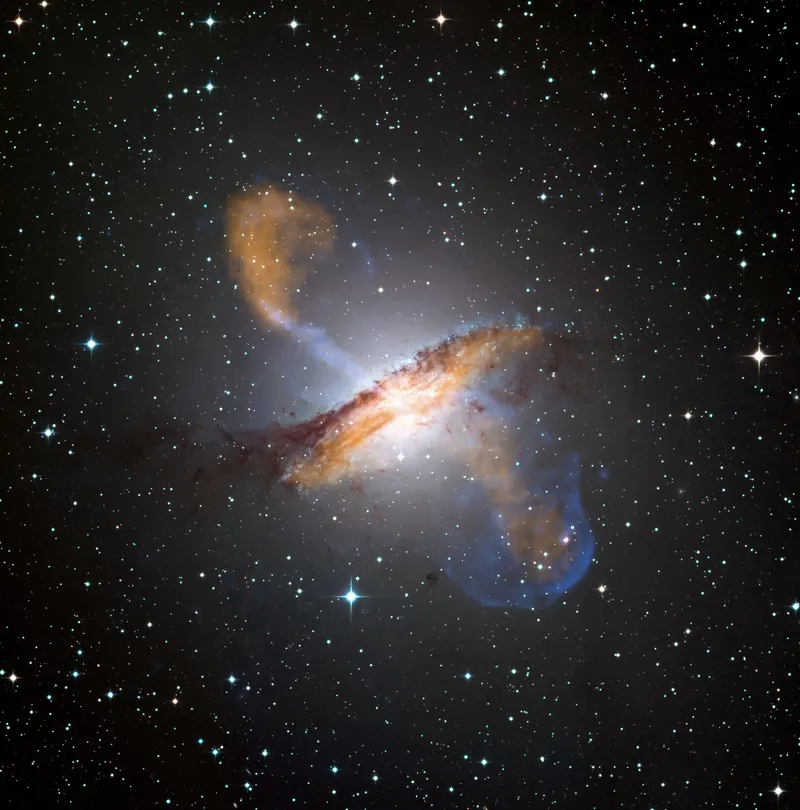
Image by ESO/WFI (Optical); MPIfR/ESO/APEX/A.Weiss et al. (Submillimetre); NASA/CXC/CfA/R.Kraft et al. (X-ray) Derivative work including grading and crop: Julian Herzog — CC BY 4.0
- What: A supermassive black hole can eject high-velocity jets of material, influencing star formation in surrounding galaxies.
- Where: At the centers of many galaxies
- When: Current research findings
- How: Through the phenomenon of relativistic jets propelled at nearly the speed of light
- Why: This challenges traditional views of black holes as mere consumers, highlighting their role in cosmic evolution.
Black holes are more than cosmic vacuum cleaners
Imagine standing at the edge of a cosmic abyss, where one of the universe's most enigmatic entities defies expectations. A supermassive black hole, long thought to consume everything that strayed nearby, has revealed a remarkable ability to eject high-velocity jets of material across vast distances. In a stunning counterpoint to its insatiable hunger, these jets can carry energy and matter deep into surrounding galaxies, influencing star formation rates in ways previously unimagined. How could such a colossus, a seemingly eternal devourer, also be a cosmic architect, shaping the very structures of our universe?
Unveiling the astonishing power of relativistic jets
At the heart of many galaxies lies a supermassive black hole, a region so dense that not even light can escape its grasp. The prevailing notion was that these cosmic giants only siphon off stars, gas, and dust that ventured too close. However, groundbreaking research utilizing Very Long Baseline Interferometry (VLBI) has begun to illuminate a different narrative. Observatories across the world have captured the extraordinary phenomenon of relativistic jets — beams of charged particles propelled at nearly the speed of light. These jets can extend over thousands of light-years, carrying energy and matter far beyond their black hole origins. This revelation sends ripples through our understanding of galactic evolution. Rather than merely consuming their surroundings, supermassive black holes play a dynamic role in their host galaxies, potentially boosting star formation rates by supplying the necessary materials for new stars to ignite. The formation mechanisms of these jets are still the subject of intense investigation, reflecting the complexity and versatility of these stellar behemoths. This duality—creation and destruction—challenges our perceptions of the black hole's role in the cosmos, eluding easy categorization and demonstrating the intricate balance between chaos and formation within the universe.
The significance of cosmic transformations in our universe
In today’s cosmological landscape, the implications of these findings extend beyond academic curiosity. Understanding how supermassive black holes influence their surroundings could redefine our approach to astrophysics and how we study galaxy formation. As researchers refine techniques and harness the power of next-generation observatories, we stand on the brink of new understandings about the universe's evolution. This knowledge might not just reshape theoretical frameworks but could alter how we view the interconnectedness of cosmic entities. The insight that a black hole not only consumes but actively transforms the very fabric of its galaxy inspires awe and prompts reflection on the forces that shape our universe. Will we uncover further secrets of these enigmatic giants, or will they continue to hold their mysteries close, swirling in the depths of the cosmos?
Did You Know?
Some black holes can launch jets of plasma that extend over millions of light-years, affecting the formation of entire galaxies.
Studies show that these relativistic jets can carry away more energy than a hundred billion suns over their lifetime.
While black holes are commonly associated with destruction, they are also sources of creation, igniting new stars in the galaxies they inhabit.
Keep Exploring
CurioWire continues to uncover the world’s hidden histories — one curiosity at a time.
Sources & References
- NASA Astrophysics Division
- American Astronomical Society
- European Southern Observatory