
🏺 Recovered from the dusty archives
The Ingenious Roman Aqueducts That Defied Time and Gravity
historyPublished 02 Dec 2025
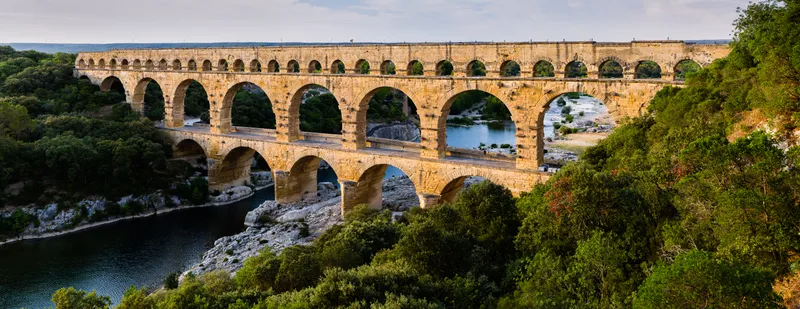
Image via Wikimedia Commons
- What: The ancient Roman aqueducts exemplify remarkable engineering that transported water using gravity alone.
- Where: Ancient Rome and surrounding regions
- When: Built between 312 BC and the early 3rd century AD
- How: The aqueducts utilized precise gradients to ensure a natural flow of water, maintaining optimal slopes for effective transport.
- Why: Their legacy continues to influence modern civil engineering and highlights the ongoing challenge of water scarcity in today's society.
A Marvel of Ancient Engineering That Endures
Imagine a world where water meanders through the landscape, traveling over valleys and mountains, carried by gravity alone. The ancient Roman aqueducts, built between 312 BC and the early 3rd century AD, exemplify this breathtaking feat of engineering. Spanning hundreds of miles, these structures not only supplied drinking water to major cities but also transformed everyday life in ancient Rome. Remarkably, some sections still stand over 2,000 years later, proving the ingenuity of Roman engineers. But how did such a sophisticated system come into being, and why does its legacy continue to resonate?
Revealing the Ingenious Structures and Their Purpose
The Romans, renowned for their innovations, created aqueducts that transported fresh water from mountains into bustling urban centers. One of the earliest and most famous, the Aqua Appia, was constructed in 312 BC and spanned approximately 16.4 kilometers. The aqueducts were built with slight gradients, allowing water to flow naturally, a method that required precise calculations to maintain an optimal slope averaging just 1 in 5000. This careful engineering ensured water remained both available and potable. However, the most staggering accomplishment is perhaps the Pont du Gard in France, a UNESCO World Heritage site. Completed around 60 AD, it stands nearly 50 meters tall and served to carry water across the Gardon River. Its three-tiered arches are not only a marvel of aesthetics but also of function, showcasing Roman mastery over materials and design. The implications of such engineering were profound. Clean water significantly improved public health, supported sanitation, and fueled an empire that at its peak boasted a population of over one million in the city of Rome. The abundant water supply permitted the construction of splendid public baths, fountains, and even private homes with running water—a lifestyle unparalleled in the ancient world. Yet, despite their brilliance, many aqueducts fell into disrepair as the empire waned. This deterioration exposes a poignant truth: even the mightiest systems can falter under changing circumstances.
The Legacy of Roman Aqueducts in Modern Society
The reason this matters today is that the Roman aqueducts serve not only as a testament to ancient ingenuity but also as a blueprint for modern civil engineering. The principles of gravity-based water transport they established reflect enduring design philosophies that influence contemporary infrastructure. For instance, many municipalities still use gravity-fed systems to bring water to their populations, a direct echo of Roman innovation. Currently, estimates suggest that one-third of the world’s population lacks access to reliable drinking water. The resilience of stringently designed aqueducts highlights a challenge: modern societies must reclaim such wisdom to address today’s water scarcity issues. Engineers and urban planners are increasingly looking to ancient systems for sustainable solutions in modern contexts. This connection implies that while technology has evolved, the fundamental need for intelligent, efficient water management remains unchanged. As we reflect on the lessons of the Roman aqueducts, one cannot help but marvel at the enduring influence of these ancient structures on our contemporary society, calling us to rethink how we manage one of our most essential resources.
Did You Know?
The Aqua Marcia, one of the longest aqueducts built by the Romans, stretched approximately 91 kilometers and was known for its exceptionally pure water.
Despite the engineering prowess of ancient Rome, the aqueducts sometimes faced significant challenges; in the Byzantine period, various aqueducts experienced neglect and damage, impacting water supply in certain regions.
Roman aqueducts inspired many modern water systems, including Washington D.C.'s water supply, which still uses gravity-fed methods for distribution today.
Keep Exploring
CurioWire continues to uncover the world’s hidden histories — one curiosity at a time.
Sources & References
- American Society of Civil Engineers
- National Park Service
- UNESCO World Heritage Centre