
🧪 Echoes from the lab
How Light Bending Revealed Hidden Galaxies in Space
sciencePublished 02 Dec 2025
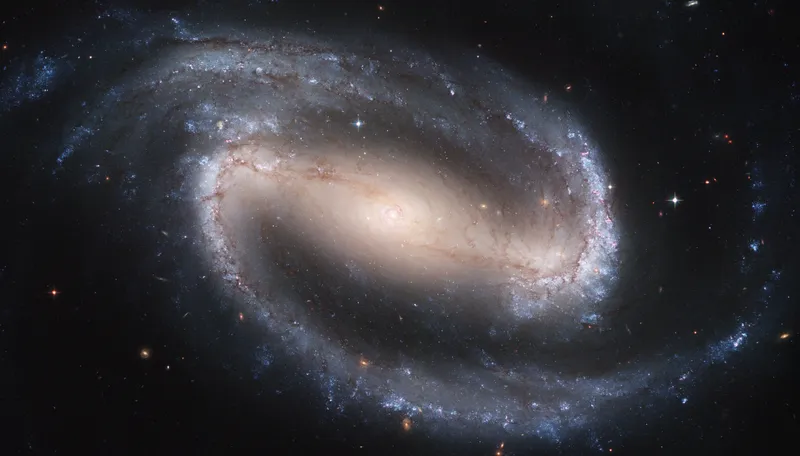
Image via Wikimedia Commons
- What: Gravitational lensing reveals hidden galaxies by bending light around massive cosmic structures.
- Where: In the universe, particularly around galaxy clusters.
- When: Since its prediction by Albert Einstein in 1912.
- How: Light bends around massive objects, allowing astronomers to detect distant galaxies that would otherwise remain invisible.
- Why: Understanding gravitational lensing enhances our knowledge of dark matter and the universe's composition.
The Unseen Connections Between Light and Reality
Mirages dance on the horizon like tantalizing winks of illusion, challenging our senses under the blistering sun. On a hot day, as the ground heats and the air above it cools, light waves bend through layers of differing temperatures, leading our eyes to perceive water where none exists. The phenomenon of mirages exemplifies how our environment manipulates perception, prompting questions about what we truly see versus what is merely an illusion.
The Astonishing Discovery of Gravitational Lensing
Gravitational lensing, a phenomenon that occurs when light bends around massive cosmic entities like galaxy clusters, has been a crucial tool for astronomers since it was first predicted by Albert Einstein in 1912. This natural spectacle enables astronomers to detect distant galaxies situated behind these colossal objects that would otherwise remain invisible. Recent advancements in imaging techniques have allowed astronomers to identify over 2,000 previously undiscovered galaxies through gravitational lensing, effectively unveiling a hidden universe only visible through the refraction of light. Just as a mirage tricks the mind into visualizing nonexistent water, gravitational lensing uncovers previously unseen cosmic structures, revealing the wonders that lurk beyond our sight.
The Impact on Modern Astronomy
The reason this matters today is that the study of gravitational lensing has transformed our understanding of the universe. It not only allows scientists to explore galaxies billions of light-years away but also to study the distribution of dark matter—the elusive substance making up most of the universe's mass. Current research estimates that about 27% of the universe consists of dark matter, indicating that we have a significant way to go in understanding cosmic composition. This insight links the optical phenomena we experience on Earth with the grand mechanics of the cosmos, illustrating that the bending of light—whether in a desert or around a massive galaxy—offers profound revelations about our reality. Such discoveries beckon us to reexamine our perceptions and embrace the mysteries enveloping the universe.
Did You Know?
Mirages are most commonly observed in hot environments, such as deserts, but can also occur in arctic regions under specific temperature gradients.
The concept of gravitational lensing was first suggested by Albert Einstein in 1912, illustrating the connection between gravity and the curvature of light.
Studies estimate that dark matter constitutes about 27% of the universe, while ordinary matter—like stars and planets—makes up only about 5%.
Keep Exploring
CurioWire continues to uncover the world’s hidden histories — one curiosity at a time.
Sources & References
- NASA — National Aeronautics and Space Administration
- American Astronomical Society — Journal of Astronomy
- European Southern Observatory — Research on Gravitational Lensing