
🎭 Fragments from the heart of civilization
The Enduring Language of Symbols and Shared Humanity
culturePublished 01 Dec 2025
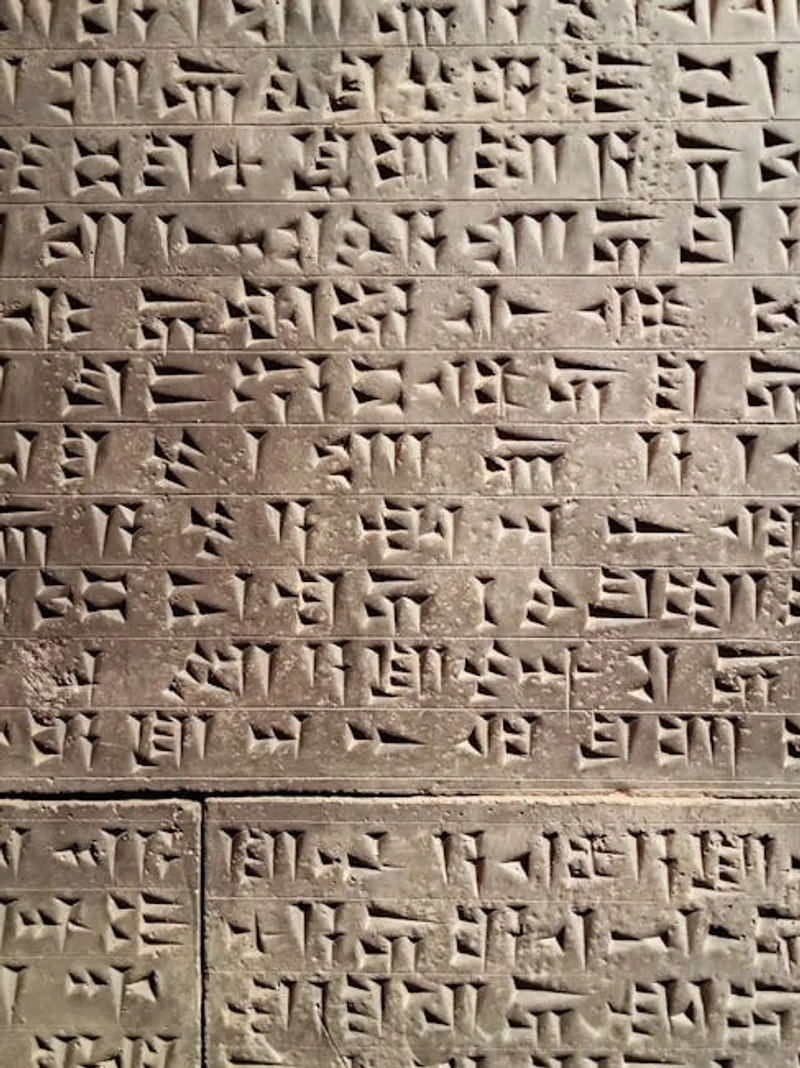
Image courtesy of Pexels
- What: Cuneiform writing, one of the earliest writing systems, emerged in ancient Mesopotamia around 3100 BCE, revolutionizing human communication.
- Where: Ancient Mesopotamia, in what is now southern Iraq
- When: Circa 3100 BCE
- How: Developed from pictographs into a complex system of wedge-shaped symbols, cuneiform documented trade, literature, and administration.
- Why: Its legacy endures today, influencing modern communication methods such as emojis, which serve as a universal language transcending cultural barriers.
A Dance of Ancient Symbols and Modern Communication
In the dim light of ancient Mesopotamia, around 3100 BCE, the air thrummed with the silent whispers of a new language. Scribes pressed their tools into clay, shaping wedge-like forms that would forever alter human expression. This cuneiform writing, crafted in the heart of Sumer, emerged from the earth, its symbols a tactile language of trade, record-keeping, and artistry. As they formed geometric shapes across the soft, warm clay, each mark vibrated with the pulse of a burgeoning civilization. Beyond mere communication, this act signified the dawn of shared human thought—a primordial journey into the depths of language that invites us to question how such ancient roots extend into our modern lives today.
The Birth and Evolution of Cuneiform Writing
Cuneiform writing, derived from the Latin word "cuneus," meaning wedge, holds the distinction of being one of the earliest writing systems known to humanity. Developed by the Sumerians in what is now southern Iraq, it began as pictographs representing objects and ideas before evolving into abstract forms consisting of countless derived symbols. This transformation took place over centuries and was pivotal in documenting everything from administrative records to epic tales like the "Epic of Gilgamesh." The adaptability of cuneiform mirrors the inherent human desire to convey complex thoughts and emotions—a testament not only to the intellect of the Sumerians but also to our shared quest for identity through symbols. The convergence of such ideas across cultures hints at an intrinsic drive within humanity, one that continues to connect us through centuries and civilizations.
The Legacy of Symbols in Contemporary Expression
The echo of cuneiform remains palpable in today’s world, notably through the evolution of modern emojis, which have become a universal form of communication. The reason it resonates now is clear: just as Sumerian scribes fashioned their clay tablets to express multifaceted human experiences, we too employ emojis to transcend language barriers and convey emotions succinctly. With over three thousand distinct emojis available, each conveys layers of meaning, bridging gaps in culture and geography. This beautiful parallel invites us to consider how we are all part of a vast, interconnected tapestry of expression—a poignant reminder of how deeply intertwined our identities are, despite the vastness of time and space.
Did You Know?
In 1979, a wealth of cuneiform tablets was discovered at the ancient city of Ur, contributing significantly to our understanding of early Mesopotamian culture.
Emojis trace their roots to Japan in the late 1990s, where they were first employed to enhance digital communication, echoing ancient methods of conveying ideas through symbols.
The word "emoji" comes from the Japanese "e" (picture) and "moji" (character), reflecting a lineage that resonates with the symbolic intentions of early writing systems.
Keep Exploring
CurioWire continues to uncover the world’s hidden histories — one curiosity at a time.
Sources & References
- The British Museum — Cuneiform Tablets Collection
- Smithsonian Institution — The History of Writing
- Journal of Near Eastern Studies — Cuneiform and Its Impact on Civilization