
🌿 Stories carved by wind and water
The Ancient Quaking Aspens That Defied Time's Passage
naturePublished 21 Nov 2025
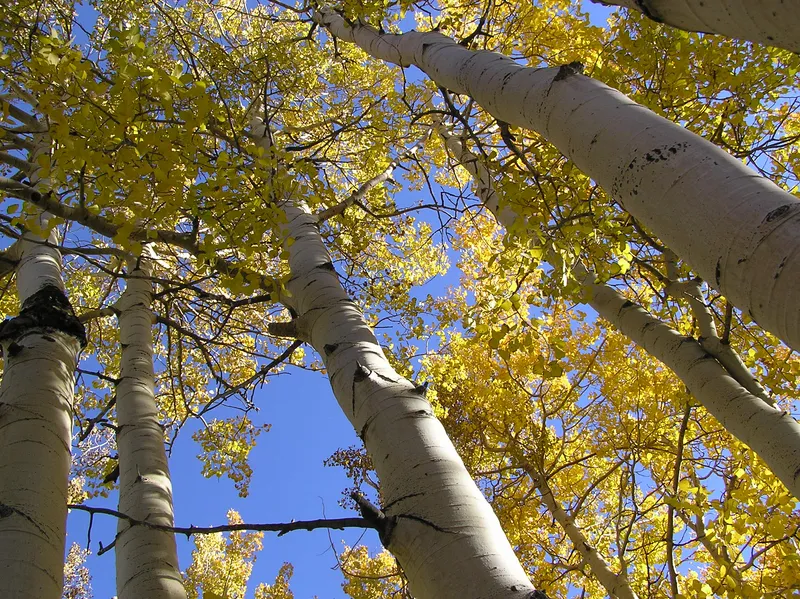
Image via Wikimedia Commons
- What: Pando, a sprawling colony of quaking aspens in Utah, is recognized as the oldest known living organism on Earth, thriving for over 80,000 years.
- Where: Fishlake National Forest, Utah
- When: Over 80,000 years ago to present
- How: Through a complex network of interconnected root systems, allowing individual trees to clone and sustain the colony.
- Why: Pando highlights the importance of ecosystem resilience and conservation in the face of climate change and human impact.
Witnessing Nature's Timeless Majesty in Utah
In the heart of Utah's Fishlake National Forest, a sprawling colony of quaking aspens stands as a testament to resilience and longevity. These ancient trees, remarkable for their ability to propagate through interconnected root systems, have existed for an astonishing 80,000 years. Their shimmering white trunks dance in the wind, wrapping the landscape in a visual cascade of green that shifts with the seasons. Each whisper of the leaves tells a story of survival through the ages, but what remarkable truths lie hidden beneath their bark?
Uncovering the Secrets of Longevity
Known as "Pando," this colony encompasses over 106 acres and is often cited as the oldest known living organism on Earth. Researchers have determined its incredible age by analyzing the growth rings of the trees, revealing a history woven into the fabric of human civilization. As this colony flourished, ancient peoples rose and fell, and climates shifted dramatically. What’s even more intriguing is that each tree in Pando is genetically identical — they are all clones of a singular organism, connected by a massive root system beneath the soil. This unique survival strategy ensures that even as individual trees die, the colony continues to thrive, adapting to challenges over millennia. By using resources efficiently and forming a complex network with neighboring organisms, the quaking aspens have navigated time's ebb and flow, forging a living link to the past.
The Enduring Legacy of Nature's Resilience
The significance of Pando today lies in its powerful reminder of nature's intricate interconnectedness. The resilience exhibited by this colony inspires a deeper appreciation for ecosystems in a world increasingly influenced by climate change and human encroachment. Local conservation efforts, such as those led by the U.S. Forest Service, focus on protecting such ancient groves, understanding that they do much more than stand as living monuments; they support entire ecosystems. Current studies show that healthy forests like Pando can positively influence local climates, absorb carbon dioxide, and provide habitats for diverse species, all while continuing their legacy of survival. Reflecting on Pando helps us rethink our relationship with nature, underscoring the belief that ancient wisdom lies not only in the stories of human history but also in the biomes that have witnessed it.
Did You Know?
- The term "Pando" is derived from the Latin word for “I spread,” reflecting the colony’s unique growth method. - Each individual tree in the Pando colony is estimated to weigh around 13 million pounds collectively, making it one of the heaviest living organisms on Earth. - Quaking aspens are known for their vibrant fall colors, turning brilliant shades of yellow and gold, attracting tourists and nature lovers alike.
Keep Exploring
CurioWire continues to uncover the world’s hidden histories — one curiosity at a time.
Sources & References
- National Park Service — Pando: The Trembling Giant
- Smithsonian Magazine — The Oldest Living Organism on Earth
- U.S. Forest Service — Conservation of Ancient Forests